
We love you and hope you have a fabulous birthday!
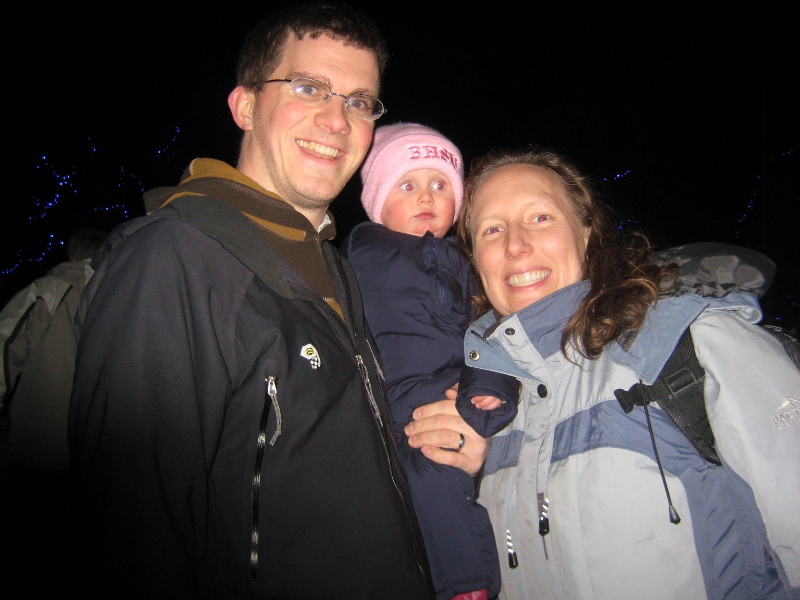
Kaitlyn is excited for you too, honest!
We love you and hope you have a fabulous birthday!
Kaitlyn is excited for you too, honest!
Enjoy being 34! 🙂
 “Well, actually, it’s my turn to wish him Happy Birthday!”
This post is part of my series, “Kickin’ It Old Skool: Why and How We Are Old-Fashioned” or KIOS for short. If you’re new to the series, please read my disclaimer before continuing on. I’m keeping a table of contents to this series here so you can see what I’ve already written about and what more there is to come.
Before getting into the nitty gritty of how we eat, I want to share some thoughts about the theological implications of what we eat. A couple years ago, one of my friends (and one of her friends) had the following conversation on Facebook (edited by me for length and reprinted here with her permission):
N:I’m enslaved to the food industry via processed food. My eyes are open now and with the Lord’s help, I will learn how to live without the evil talons of this industry.
J: Did you ever think about the fact that Satan’s very first deception of man was centered around food? I think you’re on to something that the church at large misses or ignores. I would never want my consideration of food choices to distract me from walking with Christ in His strength or from winning souls to Christ, but I fear that we ignore this area of deception that hinders our fitness and hence ability to serve Him as much as we could.
N: I’ve been blind to this up until now and never fully understood the problem. Amazing deception really. Now the hard part is finding the way out.
Until I saw this conversation on Facebook, I really hadn’t stopped to consider that there were any theological implications to the way that we eat. I am certainly not contending that by eating all organic food, one can work himself into heaven or that by eating locally, someone can claim to be holier than another. What I am arguing is that just as we can make more or less holy and God-honoring decisions in any other aspect of our life, the same is true with the food that we eat.
If we believe that we were created in God’s image (Genesis 1:27) and also that we are God’s temple (I Corinthians 3:16), then I believe that we must also accept that what we put into our bodies affects who we are and whether or not we are honoring God with our actions.
I am not contending that every Christian has to eat all organic food in order to honor God. Or that if we slip up and eat a whole bag of Oreos, somehow we’ve fallen out of God’s favor.
I’m simply saying (like N and J discuss above) that we need to mindfully consider the food that we eat, just as we should mindfully consider the media we consume (and any other aspect of our lives).
Additionally, the food we eat has great impact beyond our own bodies. When we choose to eat food that is grown or raised sustainably and ethically, we are also choosing to obey God’s command of stewardship and dominion of the earth from Genesis 1.
I definitely don’t have this all figured out. I welcome any thoughts that you have in the comments!
**************
There’s an interesting discussion in the comments of this blog post: Should Christians Do Their Best to Only Eat Organic Food?
A couple perspectives on stewardship and Christianity:
Five years ago today, I married the love of my life.
 If you were the wood, I’d be the fire.
If you were the love, I’d be the desire.
If you were a castle, I’d be your moat,
And if you were an ocean, I’d learn to float.
(from All I Want is You by Barry Louis Polisar)
Almost two years ago, Ellie joined our family and we can’t imagine life without her.

And in just a few short months, we’re eagerly anticipating the arrival of Baby B2!
Due December 30th. Hooray!!
This post is part of my series, “Kickin’ It Old Skool: Why and How We Are Old-Fashioned” or KIOS for short. If you’re new to the series, please read my disclaimer before continuing on. I’m keeping a table of contents to this series here so you can see what I’ve already written about and what more there is to come.
Before getting into the concrete details of what we eat, I want to share some of the overarching guiding principles that we use when deciding what to eat, particularly when it comes to meat, dairy, eggs, fruits, and vegetables.
First, we ask, “Can we get this locally?” If the answer is yes, (defining “local” fairly loosely as Maryland and a bit into Pennsylvania as well), then it’s definitely something that we want to consider eating, even if we don’t really like it, like beets and turnips. If the answer is “No, actually there’s never a time when we can get this locally,”** then we are likely to either not eat it or consider it a very rare treat (such as avocados). We also ask, “Can we grow this ourselves?” If the answer is yes, we’re doubly happy!
Second, we ask, “Is the food grown or raised in a sustainable manner?” By this we mean, are the animals raised in humane conditions? Would we be happy to see how the animals we are about to eat are living or would we cringe with shame? Are the vegetables and fruit grown with a minimum of pesticides, herbicides, and chemical fertilizers? Do we know and/or trust the farmer with his or her growing practices?
Third, we ask, “Is this item listed on the Dirty Dozen? Should we be buying this organically?” We tend to ask the organic question third because if we can get the item locally and we trust the farmer that the food was grown/raised in a sustainable way, the organic question is usually not as important to us. We do prioritize organic food if it’s in the Dirty Dozen (which is a list of the most heavily pesticide-laden fruits and vegetables) but if we can’t get it organically and locally, we either don’t eat it or we have figured out certain ways of making the risk acceptable to us. See, for example, my explanation of how we think about strawberries in this post.
These principles certainly don’t cover all the food that we eat but they are the important big concepts that guide our decisions. In a later post, I’ll be discussing some of the more detailed “rules” that we have (such as what we learned from In Defense of Food). I’m also going to cover each category of food specifically so I’ll take you through our food-item-specific thought processes in those posts.
Generally, though, if we know that if we consider the three principles above in our food buying decisions, we will have gone a long ways towards a more sustainable, ethical way of eating.
***************
**I also have lots of ideas for what I would do if the answer to the question, “Can we get this locally?” was “no” for almost everything we ate. This would be true, for example, if we lived in Alaska or many other parts of the rural US. If this applies to you, look for a post at the end of this series about what I would do if I couldn’t get anything locally.
So much of what I sew ends up leaving our house, destined for other people as gifts. I love being able to do this but this week, I figured I should sew something for us.
So I made a case for my new sunglasses, in the hopes that this might mean that I won’t lose the glasses in two days.


I also made a little flannel blanket for Ellie to wrap up her bunny. The one she has been using was made for me by my grandmother. I don’t want Grandma’s blanket to leave the house so this one is for going places, because we won’t mind if we lose this one.
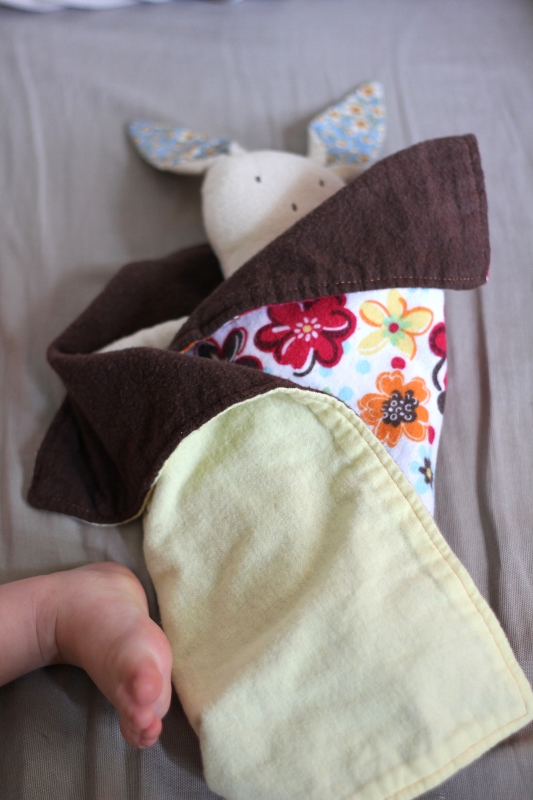
It’s fun to actually use what I sew!
Up until now, Ellie’s counting has consisted of saying, “one, one, one, one” and gesturing wildly. Then, yesterday, she pointed at my fingers and said, “One, two” and so, officially, she counts! This morning, she even added in, “Three!” one time when she and Nik were playing with her balls.
You’ll also hear another favorite word in this video. 😉
So fun!
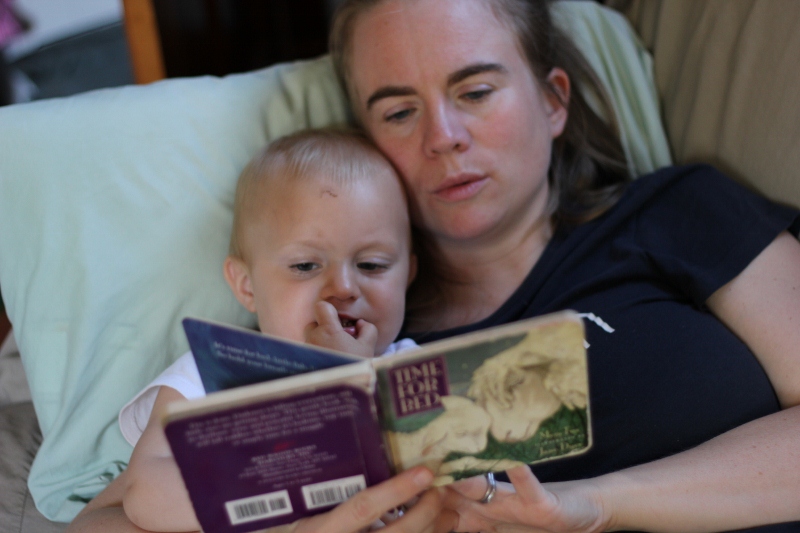
Ellie is becoming more and more attached to reading books. She’ll often bring us a book to read to her within minutes of getting out of bed.
This is currently her favorite position for reading: reclined, tucked in tight against us, soaking in love and attention. Not a bad way to read a book!





 Salmon and Souvlaki